
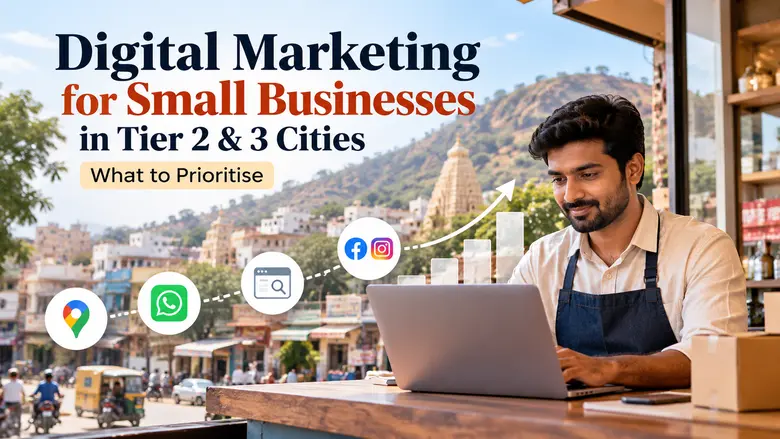
Digital Marketing for Small Businesses in Tier 2 and 3 Cities: What to Prioritise
In Tier 2 and Tier 3 cities, trust and convenience usually matter more than clever campaigns. The priorities for most local businesses are: a complete Google Business Profile with genuine reviews, an easy way to call or WhatsApp you, content in the language your customers use, and small, tightly targeted local ads once those basics are in place. Big-city playbooks built around high ad budgets and constant content often fit these markets poorly.
This guide sets out what to prioritise by business type, with a channel-priority table, a compact strategy map and clearly labelled local examples.
✔Key takeaways
- Start with free foundations: Google Business Profile, reviews and WhatsApp Business.
- Google says local ranking depends on relevance, distance and prominence, and that you cannot pay for a better local ranking.
- Speak your customers’ language, literally. Hindi or the regional language alongside English often feels more trustworthy.
- Use ads to reach nearby towns and specific neighbourhoods, not the whole state.
- Measure calls, WhatsApp chats, direction requests and “how did you hear about us?”, not just likes.
01What is different about smaller-city markets
Every city is different, but local business owners in Tier 2 and Tier 3 cities often describe a similar pattern:
- Word of mouth is powerful. People ask friends and family first, then check you online to confirm.
- Trust is personal. Customers want to see real people, real premises and real reviews.
- Conversations happen on WhatsApp and phone. Many customers prefer to message or call rather than fill in forms.
- Customers travel in from nearby towns and villages for specialist shops, clinics, coaching and wedding purchases.
- Search volumes are smaller, so broad targeting quickly spills into irrelevant audiences, while competition in some categories may be lighter than in metros.
These patterns point towards being easy to find, easy to trust and easy to contact, before spending heavily on reach.
02The foundations to set up first
- 01Google Business Profile. Google lets you manage how your business appears on Maps and Search at no charge. Choose accurate categories, add hours, photos, services and your service area, and keep them updated during festivals and holidays.
- 02Reviews. Google’s own local ranking tips say local results are based on relevance, distance and prominence, and that more reviews and positive ratings can help. Ask satisfied customers for honest reviews and reply to them, including critical ones. Never buy or fake reviews.
- 03WhatsApp Business. The WhatsApp Business app is free to download and offers a business profile, automated greeting and away messages, and a way to showcase products and services. Put the same number on your profile, website and shop board.
- 04A simple mobile-friendly website or landing page. It does not need to be large. It needs your offer, location, photos, prices or price guidance where possible, and one-tap call and WhatsApp buttons.
These steps cost mostly time. Once they are done, every rupee spent on ads or content works harder, because the people who find you can quickly see you are real and contact you easily.
03Channel priorities by business type
The table is a qualitative starting point for a typical business of each type in a smaller city. Your own customers, competition and budget may change the order.
| Business type | Priority 1 | Priority 2 | Priority 3 |
|---|---|---|---|
| Retail shop or showroom | Business Profile, photos, reviews | Instagram or Facebook showing new stock and offers | Local ads around festivals and wedding season |
| Clinic or professional service | Business Profile and reviews | Local search ads on specific services | Helpful educational content (within your profession’s advertising rules) |
| Restaurant or café | Business Profile with menu and photos | Instagram with real food and ambience | Food delivery platform listings, if relevant |
| Coaching or training institute | Business Profile, results you can verify, reviews | Search and social ads during admission windows | Short videos from faculty explaining topics |
| Home services (repair, pest control, interiors) | Business Profile with service area | Call-focused local search ads | Before-and-after photos with customer permission |
| Local manufacturer or wholesaler | Website with product details | B2B marketplace listings | Search ads for specific products beyond the city |
Professions such as medicine and law may have rules on advertising. Check what applies to you before running promotional campaigns.
04A compact local strategy map
Most local digital marketing decisions fall into one of five branches. Use this map to check nothing important is missing.
Local growth plan
- Be findable
- Business Profile categories
- City and area on website
- Consistent name, address, phone
- Be trusted
- Genuine reviews and replies
- Real photos of people and premises
- Clear prices or price guidance
- Be reachable
- WhatsApp and call buttons
- Accurate hours
- Quick replies
- Reach nearby areas
- Radius-targeted ads
- Service area settings
- Regional-language content
- Measure
- Calls and chats
- Direction requests
- “How did you hear about us?”
Text summary: be findable, be trusted, be reachable, reach nearby areas, and measure, each with two or three practical actions.
05Language, content and trust
Content that feels local usually outperforms content that looks like a national brand’s advertisement. Some practical guidelines:
- Use the language customers speak. Hindi, Rajasthani, Marathi, Gujarati or another regional language, often mixed with English, can make posts and ads feel more approachable. Keep your Business Profile clear and consistent.
- Show the owner and team. A short video of the owner explaining a product or answering a common question builds familiarity.
- Use real photos. Stock images of foreign models rarely build trust in a local market.
- Be specific about location. Mention landmarks, areas served and parking or access details.
- Plan around the local calendar. Festivals, wedding seasons, exam and admission cycles, harvest periods and, in cities such as Udaipur or Jaipur, tourist seasons all shift demand.
For businesses across Rajasthan and similar states, this local calendar often matters more than any national marketing trend. Planning content and ad budgets around it is one of the simplest ways to spend smarter.
06Reaching surrounding towns
Many businesses in district towns draw customers from a wide rural and semi-urban area. To reach them without wasting budget:
- Set your Business Profile service area accurately if you travel to customers.
- Target ads by radius or by named towns you actually serve, rather than the whole state.
- Mention travel-related information: delivery coverage, home visits, appointment booking to avoid long waits.
- Create separate location pages only when you genuinely serve that location with something specific to say, not duplicate pages with swapped town names.
07Illustrative local examples
Illustrative example
A jewellery showroom in a district town
A hypothetical family jeweller relies on word of mouth. Before the wedding season, it updates its Business Profile with current photos, asks recent customers for reviews, and posts short videos of new designs in Hindi. It then runs small ads aimed at nearby towns inviting people to book a showroom visit on WhatsApp. Staff ask every visitor how they heard about the store and note it in a register.
Illustrative example
A physiotherapy clinic in a Tier 2 city
A hypothetical clinic finds that most patients discover it through doctor referrals and then check it on Google Maps. It focuses on accurate hours, clear service descriptions, replies to every review and a WhatsApp booking option, and it runs a modest search campaign only for specific treatment terms within its catchment area.
Both businesses are invented to show how priorities apply. They are not Brand Chanakya clients, and no results are implied.
Brand Chanakya works with SMEs in Udaipur and other Tier 2 and Tier 3 markets; our SME and MSME digital marketing page explains the local SEO, ads and social media support we offer.
08A simple monthly routine
Local marketing works best as a steady habit rather than an occasional burst. A routine that an owner or one staff member can manage might look like this:
- 01Week 1: check your listings. Confirm hours, phone number, photos, and any upcoming holiday closures on your Business Profile and website.
- 02Week 2: reviews and replies. Request reviews from recent satisfied customers and reply to every new review, including critical ones, calmly and specifically.
- 03Week 3: fresh content. Post new stock, a common customer question answered on video, or a behind-the-scenes photo, in the language your customers use.
- 04Week 4: review numbers. Look at calls, direction requests, WhatsApp chats, website inquiries and what customers told you about how they found you. Decide one thing to change next month.
If you run ads, add a quick weekly check of search terms or audience locations to make sure spend is staying within the areas you serve. Before festivals and seasonal peaks, start this routine a few weeks earlier so your profile and content are ready when demand rises.
09Common mistakes and how to avoid them
Small businesses in Tier 2 and Tier 3 cities should avoid common digital marketing mistakes, such as ignoring local SEO, using generic content, and relying only on paid ads. Focus on building local trust, maintaining an updated Google Business Profile, responding to customer reviews, and tracking leads to identify which marketing activities deliver the best results.
!Copying metro campaigns
Glossy, English-only creative and state-wide targeting can miss local customers. Keep it local, human and specific.
!Chasing followers instead of customers
A large following from outside your area does not bring footfall. Measure calls, chats and visits.
!Outdated profile information
Wrong hours or an old phone number on Google Maps loses customers who arrive to a closed shutter. Review your profile monthly.
!Slow replies on WhatsApp
If messages sit unanswered for a day, the customer has often gone elsewhere. Set away messages and a reply routine.
10The bottom line
For small businesses in Tier 2 and Tier 3 cities, digital marketing starts with being findable, trusted and reachable, and only then scaling reach with ads and content. Get the free foundations right, speak your customers’ language, plan around the local calendar, and measure the calls and visits that actually matter to your business.
11Frequently asked questions
Is digital marketing useful if most of my customers come through referrals?
Yes. Referred customers often check you online before calling or visiting. A strong profile and reviews help turn referrals into visits, even if the referral started offline.
Should my content be in Hindi or English?
Use whatever your customers use. Many local businesses mix both. Test posts and ads in each and see which gets more genuine inquiries.
How small can a local ad campaign be?
Platforms let you set modest budgets. The key is narrow targeting: specific services, a tight radius and clear contact options. A small, focused campaign is usually better than a thinly spread one.
Can I appear in “near me” searches without a shop?
Service-area businesses that visit customers can set up a Business Profile with a service area rather than a public address, subject to Google’s eligibility rules.
How do I know if my online efforts are working?
Track Business Profile calls and direction requests, WhatsApp chats and website inquiries, and ask every new customer how they found you. Review monthly.
Running a business outside the metros?
Tell us your city, what you sell, and the areas you serve. Ask for a plan that starts with the foundations, not the biggest budget.
📚 You Might Also Like
Digital Marketing Checklist for MSMEs: 7 Things to Set Up Before Running Ads
How to Choose a Digital Marketing Agency for Your SME or MSME
Qualified B2B Lead Generation for MSMEs: A Practical Guide
Digital Marketing Services for SMEs & MSMEs