
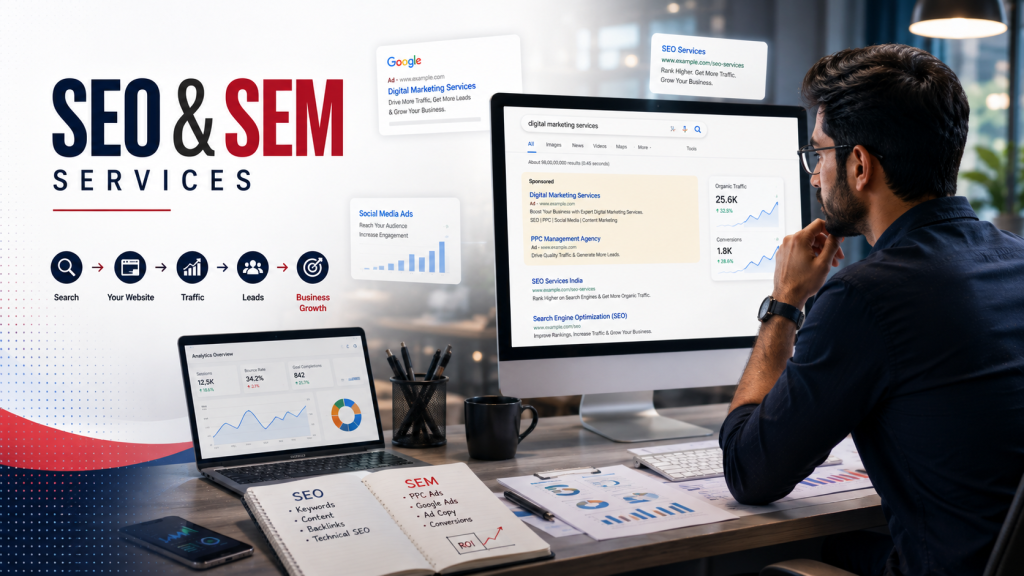
🔍 What Are SEO & SEM?
SEO (Search Engine Optimization) earns free, organic rankings over time. SEM (Search Engine Marketing) — usually Google Ads — buys immediate visibility. Together they cover both the long game and the short game of getting found on Google.
SEO changes your website so Google trusts and ranks it naturally. SEM pays Google directly to show your ad above those organic results, instantly.
Diagram — SEO vs SEM Flow
→
→
→
→
→
→
Most businesses discover SEM first — it’s fast, and a Google Ads account can be live within a day. SEO takes longer to show results but eventually becomes the channel with the lowest cost per lead, since you stop paying per click once you rank.
The two disciplines pull the same lever from opposite directions. SEO earns Google’s trust through relevance signals — content depth, technical health, backlinks, and user experience — accumulated over months. SEM rents visibility instantly through an auction, where the highest effective bid (adjusted for relevance) wins the placement. Neither is “better” in isolation; they solve different timing problems for the same business.
Key Takeaways
- ✓SEO is an owned asset that keeps working after you stop actively investing in it; SEM is rented visibility that disappears the day you stop paying.
- ✓SEM data (which keywords convert) is one of the fastest ways to validate what SEO content is worth writing.
- ✓A mature digital strategy in India typically allocates both — SEM for immediate pipeline, SEO for the next 12-24 months of compounding traffic.
Decision Framework
Need leads this month? Start with SEM. Building a business you’ll still own in 3 years? Start SEO in parallel, even at a modest pace, because the earlier you start, the sooner it compounds.
⚖️ SEO vs SEM: The Real Comparison
| Factor | 🌐 SEO | 🎯 SEM |
|---|---|---|
| Speed to results | 3–6+ months | Same day to a few days |
| Cost behaviour | Investment upfront, free traffic after | Pay for every click, ongoing |
| Longevity | Compounds, stays after work stops | Stops the moment spend stops |
| Trust factor | Higher — users trust organic results more | Lower per-click trust, but prime placement |
| Best use case | Long-term brand equity, category authority | Launches, seasonal pushes, immediate pipeline |
| Investment pattern | Steady monthly retainer | Ad spend + management fee, scalable daily |
Pro Tip
Don’t choose one — sequence them. Run SEM to generate leads now, while SEO content builds the organic asset that lowers your cost per lead over the next 6–12 months.
✅ SEO Pros
Compounds over time, builds long-term trust, no per-click cost, works while you sleep once rankings stabilize.
⚠️ SEO Cons
Slow to start, results depend on competition, algorithm updates can shift rankings without warning.
✅ SEM Pros
Immediate visibility, precise targeting, full budget control, easy to test offers and messaging fast.
⚠️ SEM Cons
Costs scale with competition, traffic stops the day spend stops, requires ongoing management to stay efficient.
In practice, the ROI comparison isn’t a straight line — SEM’s ROI is visible almost immediately and stays roughly flat unless you optimize; SEO’s ROI often looks negative in month one and two, crosses breakeven around month four to six, and then keeps climbing as more pages rank and compound. Businesses that judge SEO by a 30-day scoreboard usually quit right before it starts paying off.
💡 Why Businesses Need SEO & SEM Together
📉 Problem: Invisible on Google
Competitors rank for the exact terms your customers search — every day you’re absent from page one is a day of free traffic going to them instead.
💸 Problem: Rising ad costs
Relying only on ads means CAC keeps climbing with every auction cycle, since more advertisers enter every category every year.
🐢 Problem: Slow organic growth alone
SEO-only businesses miss immediate revenue while rankings build, often losing early-mover advantage to a faster-moving competitor.
The fix is running both in parallel: SEM fills the pipeline today, SEO builds the moat that protects you from rising ad costs tomorrow. Businesses that only do one tend to either burn cash on ads forever, or wait too long for organic traffic to matter.
📈 90%+
of clicks in most searches go to results on page one — invisibility beyond that is functionally invisibility, period.
⏱️ 53%
of e-commerce traffic in most markets originates from organic and paid search combined, ahead of social and direct.
💰 3-5x
typical CAC difference between a well-ranked organic page and a purely paid-acquisition funnel over 12 months.
🔁 60%+
of B2B buyers research a vendor on Google before ever filling out a contact form.
These aren’t guarantees for every business — but they explain why category leaders rarely pick one channel and ignore the other. The businesses we see struggle most are the ones treating SEO and SEM as competing budget lines instead of two stages of the same growth engine.
🚀 Ready to Grow Your Business?
Get a FREE SEO & SEM consultation from Brand Chanakya.
📌 Our SEO Services
From technical foundations to content and links — a full-stack SEO service built for how Google (and AI search) actually ranks pages today.
🔍 Keyword Research
Search-volume and intent mapping to your buyer journey.
🕵️ Competitor Analysis
Gap analysis on rankings, content, and backlinks.
📝 On-Page SEO
Titles, meta, headers, and content structure per page.
⚙️ Technical SEO
Crawlability, indexation, site architecture health.
🌐 Local SEO
Google Business Profile + local pack visibility.
🏢 Enterprise SEO
Multi-location, multi-template SEO at scale.
📰 Content SEO
Topic clusters and pillar pages built for authority.
🖼️ Image SEO
Compression, alt text, and structured image data.
🎬 Video SEO
YouTube and on-site video discoverability.
🌍 International SEO
Hreflang and multi-region targeting.
🧠 AI SEO / GEO
Structuring content so AI engines cite you.
🛒 Ecommerce SEO
Category, product, and collection page optimization.
🩺 SEO Audit
Full technical + content + backlink health check.
🚑 Penalty Recovery
Diagnosing and reversing algorithmic or manual drops.
🔗 Link Building
Relevant, editorial backlinks — not spam directories.
🧩 Schema Markup
Structured data for rich results and AI parsing.
⚡ Core Web Vitals
LCP, INP, and CLS tuned to Google’s thresholds.
🏎️ Site Speed
Load-time optimization across mobile and desktop.
🔀 Internal Linking
Architecture that passes authority to priority pages.
📍 GBP Optimization
Categories, posts, Q&A, and review strategy.
Deep Dive: Our 4 Flagship SEO Services
| Service | Process | Deliverables | Expected Outcome | Best Suited For |
|---|---|---|---|---|
| ⚙️ Technical SEO | Crawl audit → fix indexation → Core Web Vitals | Audit report, fix log, speed benchmarks | Improved crawl efficiency and rankings stability | Any site with 50+ pages |
| 🌐 Local SEO | GBP optimization → citations → review strategy | Optimized GBP, citation list, review workflow | Local pack visibility, more calls & directions | Clinics, showrooms, service businesses |
| 🏢 Enterprise SEO | Template audit → scalable content system | SEO framework doc, template guidelines | Rankings across hundreds of pages, not one-offs | Multi-location, marketplaces, large catalogs |
| 🧠 AI SEO / GEO | Entity mapping → structured answers → schema | GEO-optimized content, FAQ schema, entity brief | Citations in ChatGPT, Gemini, Perplexity answers | Category leaders wanting AI-search visibility |
🎯 Our SEM Services
| Format | How It Works | Ideal Budget | Best Industries | Expected KPI |
|---|---|---|---|---|
| Search Ads | Text ads on high-intent keyword searches | ₹30k+/mo | Healthcare, real estate, services | CPA, conversion rate |
| Display Ads | Banner ads across the Display Network | ₹15k+/mo | Retargeting for any category | CTR, view-through conversions |
| Shopping Ads | Product listings with image + price in search | ₹40k+/mo | Ecommerce, D2C | ROAS |
| Performance Max | AI-driven, spans Search/Display/YouTube/Gmail | ₹50k+/mo | Ecommerce, lead gen at scale | ROAS, CPA |
| Demand Gen | Visual ads across YouTube, Discover, Gmail | ₹30k+/mo | D2C, lifestyle brands | Engagement, assisted conversions |
| Remarketing | Re-targets past site/app visitors | ₹10k+/mo | Any category with a sales funnel | ROAS, lower CPA |
| YouTube Ads | Skippable/non-skippable video ads | ₹25k+/mo | Brand storytelling, launches | View rate, brand lift |
| Call Ads | Click-to-call focused search ads | ₹20k+/mo | Clinics, home services | Cost per call |
| Lead Ads (Meta) | In-platform lead forms, no landing page needed | ₹20k+/mo | Real estate, education | Cost per lead |
| App Campaigns | Drives installs/in-app actions across Google properties | ₹40k+/mo | App-based businesses | Cost per install |
| Local Campaigns | Drives footfall via Maps + Search + Display | ₹15k+/mo | Showrooms, retail, clinics | Store visits, directions |
| B2B / B2C Campaigns | Tailored targeting by funnel and deal size | Varies by scope | All — structured by objective | SQLs / revenue |
⚙️ Our Process
→
→
→
→
→
- ✓Research — audit, keyword mapping, competitor gap analysis
- ✓Planning — priority roadmap tied to business goals
- ✓Implementation — technical fixes, content, campaign builds
- ✓Optimization — weekly review of rankings, CPA, ROAS
- ✓Scaling — expand what’s proven, cut what isn’t
- ✓Reporting — transparent dashboards, monthly review calls
🔗 SEO + SEM Working Together
→
→
→
→
→
→
→
→
SEM data (which keywords convert, which landing pages win) directly informs SEO content priorities — and SEO rankings reduce reliance on paid clicks for the same terms over time, lowering blended CAC.
🏭 Industry Solutions
| Industry | SEO Focus | SEM Focus |
|---|---|---|
| 🏠 Real Estate | Project + locality pages | Meta lead ads, Google Search |
| 🩺 Healthcare | Doctor + treatment pages, local SEO | Search + Call Ads |
| 🎓 Education | Course + admissions pages | Meta + Search, seasonal pushes |
| 🏭 Manufacturing | Product + capability pages | LinkedIn + Search |
| 💍 Jewellery | Category + collection SEO | Meta storytelling ads |
| 🏨 Hospitality | Local + booking-intent pages | Search + Meta seasonal offers |
| 🏗️ Construction | Service area + project pages | Search + Local Campaigns |
| 🛋️ Interior Design | Portfolio + city pages | Meta visual ads |
| 🚗 Automobile | Model + service pages | Search + Local Campaigns |
| 💰 Finance | Product + compliance-safe content | LinkedIn + Search |
| 📦 Export | International SEO, B2B content | LinkedIn + Search |
| 🛍️ D2C / Ecommerce | Category, product, content SEO | Shopping, PMax, Meta |
🧰 Tools We Use
Search Console
Ahrefs
SEMrush
Screaming Frog
PageSpeed Insights
Looker Studio
Google Tag Manager
Meta Pixel + CAPI
📊 Case Study Style Examples
Illustrative examples of the kind of movement we track — actual figures vary by client, industry, and starting baseline.
| Metric | Before | After 6 Months |
|---|---|---|
| Organic traffic | 1,200 visits/mo | 4,800 visits/mo |
| Keywords in Top 10 | 8 | 62 |
| Google Ads ROAS | 1.8x | 3.6x |
| Monthly qualified leads | 15 | 58 |
📈 Reporting Dashboard
📅 Weekly Reports
Spend pacing, ranking movement, quick wins.
🗓️ Monthly Reports
Full KPI dashboard with trend lines.
💰 Revenue Reports
Leads and sales tied back to source campaign.
🚀 SEO Timeline: What to Expect
⚠️ Common Mistakes
- ⚠Expecting SEO results in 30 days — it’s a 3-6 month minimum game.
- ⚠Running SEM with no landing page strategy — clicks without conversions.
- ⚠Ignoring technical SEO while publishing content on a slow, unindexed site.
- ⚠Stopping SEO the moment rankings improve — momentum needs maintenance.
Warning
Any agency promising a “Page 1 in 7 days” guarantee for competitive keywords is a red flag — that timeline is not how Google’s algorithm works.
🏆 Why Brand Chanakya
📊 Data-Driven
Every decision traced to a metric, not a hunch.
🔍 Transparent
You see the same dashboard we do.
🎯 ROI-Focused
Budgets follow proof, not trends.
🌐 Pan-India
Delivering across 11+ industries nationwide.
🎯 Ready to Rank and Convert?
Get a free SEO & SEM consultation — audit, competitor gap analysis, and a growth roadmap built for your business.
❓ 40 Frequently Asked Questions
What is the difference between SEO and SEM?
SEO earns free, organic rankings by improving your site’s relevance and authority over time. SEM buys immediate visibility through paid ads like Google Ads. SEO compounds slowly; SEM delivers instantly but stops when spend stops.
How long does SEO take to show results?
Most sites see early movement within 60-90 days and meaningful ranking gains by month 4-6, depending on competition and starting domain authority. Highly competitive keywords can take 9-12 months.
Can I do SEM without SEO, or vice versa?
Yes, but each has a gap the other fills. SEM-only means paying for every visitor forever; SEO-only means waiting months before seeing meaningful traffic. Running both covers immediate and long-term growth.
What is technical SEO?
Technical SEO covers the backend health of a site — crawlability, indexation, site speed, mobile-friendliness, and Core Web Vitals — the foundation that determines whether Google can properly access and rank your content at all.
What is local SEO and who needs it?
Local SEO optimizes your visibility for “near me” and location-based searches, primarily through Google Business Profile. It’s essential for clinics, showrooms, restaurants, and any business relying on local footfall or service-area customers.
What is Enterprise SEO?
Enterprise SEO applies SEO principles at scale across hundreds or thousands of pages — multi-location businesses, marketplaces, and large catalogs — using templated systems rather than one-off page fixes.
What is AI SEO or GEO (Generative Engine Optimization)?
GEO structures your content so AI systems like ChatGPT, Gemini, and Perplexity can extract and cite it in generated answers — using clear definitions, structured data, and entity-rich writing, alongside traditional SEO.
What is Google Ads Performance Max?
Performance Max is an AI-driven Google Ads campaign type that runs across Search, Display, YouTube, Gmail, and Maps from a single feed and budget, optimizing placement automatically based on your conversion goal.
How much does Google Ads management cost?
Management fees vary by agency and are typically separate from ad spend itself — often a flat monthly fee or a percentage of spend. Transparent agencies disclose both figures separately rather than bundling them.
What is a good budget to start SEM?
Most Indian SMEs can meaningfully test one channel starting around ₹20,000-₹30,000 per month, enough to gather early conversion data before scaling further.
What is Core Web Vitals and why does it matter?
Core Web Vitals are Google’s page experience metrics — Largest Contentful Paint, Interaction to Next Paint, and Cumulative Layout Shift — measuring load speed, responsiveness, and visual stability, which factor into rankings.
What is schema markup?
Schema markup is structured data added to your site’s code that helps search engines (and AI systems) understand your content precisely — enabling rich results like star ratings, FAQs, and breadcrumbs in search listings.
Do backlinks still matter for SEO in 2026?
Yes — relevant, editorially earned backlinks remain one of the strongest ranking signals, though quality now matters far more than quantity. A handful of authoritative links outperforms hundreds of low-quality directory links.
What is a keyword research process?
Keyword research maps what your audience actually searches for, at what volume, and with what intent, then groups those terms into content and page priorities aligned to your buyer journey.
What is the ideal content strategy for SEO?
A pillar-and-cluster model works best — one comprehensive pillar page on a core topic, linked to multiple supporting articles on related subtopics, building topical authority Google can recognize.
What is Google Business Profile optimization?
It involves selecting accurate categories, adding photos and posts regularly, responding to reviews, and keeping information current — all of which influence your ranking in the local map pack.
How is ecommerce SEO different from regular SEO?
Ecommerce SEO focuses heavily on category and product page optimization, faceted navigation handling, and structured data for pricing and reviews — alongside the usual technical and content fundamentals.
What is penalty recovery?
Penalty recovery diagnoses why a site lost rankings — whether from an algorithm update or a manual action — and systematically fixes the underlying issue, whether it’s thin content, spammy links, or technical problems.
What is internal linking and why does it matter?
Internal linking connects related pages on your own site, helping Google understand page relationships and passing authority to the pages you most want to rank.
Should I hire an SEO agency or freelancer?
Agencies typically offer a full team — technical, content, and reporting — under one roof, suited to businesses wanting comprehensive coverage. Freelancers can work well for narrow, well-defined tasks with a smaller budget.
What is a Google Ads Quality Score?
Quality Score rates how relevant your ad, keyword, and landing page are to a searcher. Higher scores lower your CPC and improve ad position, rewarding relevance over raw bid size.
What is remarketing in SEM?
Remarketing shows ads specifically to people who already visited your site but didn’t convert, using pixel or tag data to build a warm audience — typically one of the highest-ROI tactics in a paid strategy.
Can small local businesses compete with big brands on Google Ads?
Yes — auction algorithms reward relevance and Quality Score, not just budget. A well-targeted local campaign with a tight landing page can outperform a larger, generically-targeted competitor.
What is the difference between organic and paid search results?
Organic results are earned through SEO and shown for free based on relevance; paid results are ads marked “Sponsored” that appear because a business paid for that placement via Google Ads.
How often should an SEO strategy be reviewed?
Monthly reviews are typical — checking ranking movement, traffic trends, and technical health — with a deeper quarterly review to reassess content priorities and competitive positioning.
What is a content cluster or pillar page?
A pillar page is a comprehensive resource on a core topic, linked to several supporting “cluster” articles on related subtopics — a structure that signals topical depth to search engines.
Does site speed really affect rankings?
Yes — site speed is part of Core Web Vitals, a confirmed ranking factor, and it also directly affects conversion rate, since slower pages consistently lose visitors before they convert.
What is International SEO?
International SEO targets multiple countries or languages using hreflang tags and region-specific content, ensuring the right version of your site appears to the right audience.
How do I know if my SEO agency is doing a good job?
Ask for direct access to Search Console and analytics data (not just PDF reports), check whether rankings and organic traffic are trending upward over 3-6 months, and confirm technical fixes are actually documented and shipped.
What is Demand Gen in Google Ads?
Demand Gen is a visually-rich Google Ads format running across YouTube, Discover, and Gmail, designed to build consideration and demand before someone actively searches.
What is a landing page’s role in SEM success?
The landing page determines whether ad clicks actually convert — a dedicated, focused page built around one offer typically converts significantly better than sending traffic to a general homepage.
What is GA4 and why do I need it?
GA4 (Google Analytics 4) tracks user behaviour across your entire site independent of any single ad platform, giving a full picture of the customer journey that individual platform dashboards can’t show alone.
Is SEO still worth it with AI search growing?
Yes — AI search engines still largely draw from indexed, well-structured web content, so strong SEO fundamentals plus GEO practices (clear structure, schema, entity clarity) improve your chances of being cited in AI-generated answers too.
What industries see the fastest SEM results?
Categories with high-intent search behaviour — healthcare, real estate, and local services — tend to see the fastest measurable results because Search Ads capture existing, active demand.
What is a Core Web Vitals audit?
It’s a technical review measuring your site’s LCP, INP, and CLS scores against Google’s thresholds, followed by a prioritized fix list for the pages most affecting user experience and rankings.
Can SEO and SEM share the same keyword data?
Yes, and they should — SEM campaigns generate fast conversion data on which keywords actually drive sales, which then informs which topics SEO content should prioritize.
What is link building and is it safe?
Link building is earning backlinks from other relevant websites to build authority. Done through genuine outreach, guest content, and PR, it’s safe and effective; done through paid link schemes or spam directories, it risks penalties.
How does mobile SEO differ from desktop SEO?
Google primarily uses mobile-first indexing, meaning your mobile site version is what’s evaluated for rankings — so mobile load speed, tap-friendly design, and readable text size are critical, not optional.
What reports will I receive as a client?
Typically a weekly snapshot of spend and ranking movement, plus a full monthly report covering KPI trends, completed work, and next month’s priorities — accessible via a live dashboard, not just static PDFs.
How do I get started with Brand Chanakya?
Book a free consultation where we review your current site and campaigns, run a quick audit, and outline a realistic roadmap and budget before any commitment is made.
📚 Related Reading
Technical SEO: The Complete Guide
Section 04 above covers Technical SEO briefly — this is the full crawlability, indexation, and Core Web Vitals playbook.
SEO Cost in India: Complete Guide
Answers the “What is a good budget to start SEM?” FAQ in more depth — full SEO pricing breakdown for India.
Performance Marketing: The Complete Guide
Going deeper on the SEM side — Performance Max, Shopping, remarketing, and ROAS strategy covered in Section 05 above.