
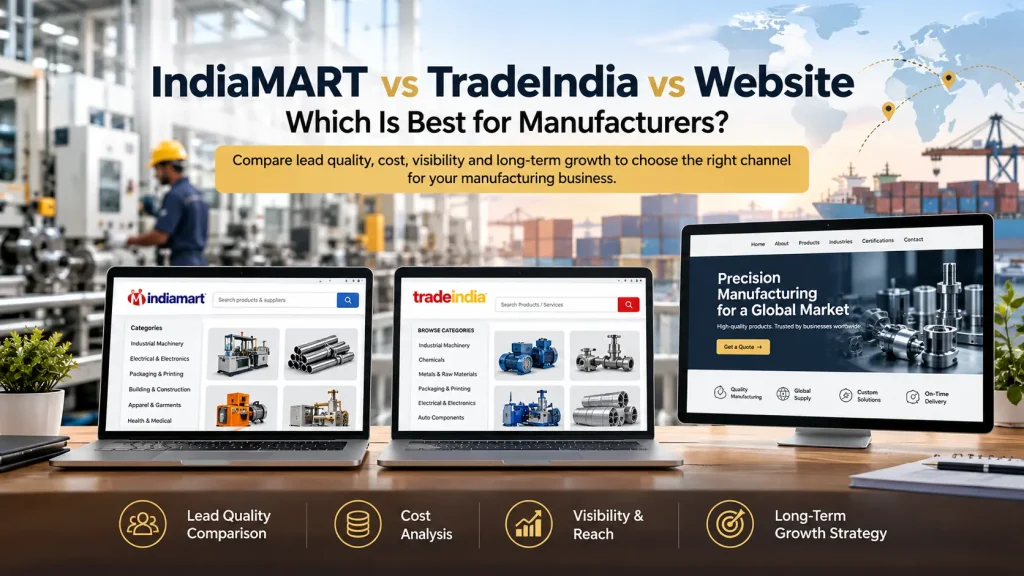
IndiaMART vs TradeIndia vs Website: Which Is Best for Manufacturers?
IndiaMART vs TradeIndia vs Website — discover how these three channels compare in lead quality, cost, visibility, and long-term business growth. Learn which platform is best for generating B2B enquiries, reaching OEM buyers, and building credibility for your manufacturing business, and how to use all three together for a stronger digital presence.
Nearly every manufacturing company we talk to is already listed on IndiaMART, has heard of TradeIndia, and has a website that hasn’t been meaningfully updated in years. The question isn’t whether to use all three — eventually, most serious manufacturers do. The real question, especially for a company with a limited marketing budget, is sequencing: which one deserves the next investment of time and money, and why the other two aren’t a substitute for it.
This decision trips up more manufacturers than it should, mostly because trade portals and websites get compared as if they’re competing for the same job. They’re not. One is rented shelf space in a crowded marketplace; the other is real estate you own outright. Understanding that distinction — not just comparing lead counts — is what actually makes this decision straightforward.
📊 Quick Comparison Snapshot
| Factor | IndiaMART | TradeIndia | Own Website |
|---|---|---|---|
| Lead volume | High | Moderate | Low to moderate, but highest quality |
| Lead quality | Mixed — many price-shoppers | Mixed, slightly more industrial-focused | Highest — self-selected, already vetted you |
| Ownership | Rented — platform controls visibility | Rented — same constraint | Fully owned, compounds over time |
| Setup time | Fast — days to weeks | Fast — days to weeks | Slower — weeks to months for a proper build |
| Best for | Fast initial visibility, domestic sourcing | Secondary domestic coverage | OEM/Tier-1 credibility, long-term SEO compounding |
Read this table as a starting orientation, not a final verdict — the right mix still depends heavily on your category, your typical buyer’s sourcing habits, and how much of your pipeline currently comes from domestic versus export markets. The sections below walk through each channel in enough depth to make that call for your specific business.
🟠 IndiaMART — The Volume Channel
🟠 IndiaMART:Widest domestic reach
IndiaMART remains the single largest B2B marketplace in India by buyer traffic, which makes it the fastest way for a manufacturer to get discovered domestically. Its strength is volume and speed — a well-optimized listing can start generating enquiries within days. The trade-off is lead quality: because the barrier to sending an enquiry is so low, a meaningful share of IndiaMART leads are price-comparison shoppers or small buyers who never intended to place a serious order.
Getting real value out of IndiaMART is less about being present and more about how the listing is optimized — accurate categorization, complete product specifications, and responsive lead handling all meaningfully affect both visibility and the quality of enquiries you receive. A neglected, half-filled IndiaMART profile tends to attract exactly the low-intent traffic manufacturers complain about, while a properly optimized one filters at least some of that noise out before it reaches your inbox.
🔵 TradeIndia — The Secondary Net
🔵 TradeIndia Complementary coverage
TradeIndia operates on a similar model to IndiaMART with meaningfully smaller reach, which makes it a genuinely useful secondary channel rather than a replacement for either IndiaMART or your website. Some buyer segments — particularly in certain industrial categories — check TradeIndia specifically as a second opinion after IndiaMART, so being absent from it can quietly cost you a shortlist spot even if it never drives your primary lead volume.
The practical approach most manufacturers land on is treating TradeIndia as low-effort, high-leverage coverage: a properly filled listing that mirrors your IndiaMART profile, updated on the same cadence, without dedicating significant separate budget or attention to it. It rarely justifies being a primary channel on its own, but leaving it empty while competitors maintain a presence there is an easy gap to close.
🌐 Your Own Website — The Asset You Actually Own
🌐 Website:Highest lead quality, compounding value
Unlike a trade portal listing, your website is an asset you fully control — its ranking, its content depth, its ability to showcase certifications and case studies exactly the way you want. It’s also where the OEM vendor-vetting stage described in our guide to generating qualified OEM leads actually plays out. A buyer who found you on IndiaMART will still check your website before shortlisting you — which means a thin or outdated website can quietly undermine leads generated everywhere else.
The compounding effect is what ultimately separates a website from a rented listing. A capability page that ranks organically for a process-specific search term keeps generating visibility for years with modest ongoing maintenance, while a trade portal listing’s visibility disappears the moment you stop paying for the placement. For manufacturers thinking beyond the next quarter, that difference alone usually settles where the larger long-term investment belongs.
🧭 Decision Framework: Where to Invest First
Rather than a single universal answer, here’s how the right starting investment shifts based on your business stage and goals. Score your own situation against these three profiles and let the strongest match guide where your next budget goes:
💡
If you can only invest in one thing properly this quarter, invest in your website. It’s the one channel every OEM buyer checks regardless of where they first found you, and it’s the only one of the three whose value compounds — SEO rankings and content built today keep working years from now, unlike a trade portal listing you’re renting month to month.
🔀 Using All Three Together
The most effective setup we see isn’t a choice between these three — it’s a sequenced role for each. IndiaMART and TradeIndia function as top-of-funnel discovery, casting a wide net for initial visibility, especially for domestic and smaller-volume buyers. Your website then functions as the vetting and credibility layer every serious buyer checks before shortlisting you, regardless of which channel they arrived from. Used this way, trade portals and your website aren’t competitors for the same budget — they’re different stages of the same buyer journey.
A useful way to think about the split: trade portals answer “who’s out there that does this?” while your website answers “can I actually trust this specific company?” Both questions matter, but they get answered by different assets, at different points in a buyer’s research — which is exactly why relying on only one, however well it’s optimized, leaves a gap the other was built to fill.
🚩 What Not to Rely On Alone
Each of these three channels has a specific failure mode when treated as a complete solution on its own rather than one piece of a broader presence:
🏠
A trade portal listing as your only presence
Without a website to back it up, serious OEM buyers often drop off during the vetting stage.
🖼️
An outdated website
A site last updated years ago undermines credibility even when your actual capabilities have grown significantly since.
📵
No LinkedIn presence at all
Increasingly, procurement teams cross-check a company’s LinkedIn activity as part of standard vetting, regardless of where the lead originated.
💰
Chasing IndiaMART volume without a filter
Without minimum order and ideal client signaling, high lead volume from trade portals just means more time spent filtering unqualified enquiries.
Trade portals get you found. Your website gets you trusted. You need both, but they’re not interchangeable.
One more distinction worth making explicit: cost structure. Trade portal subscriptions are an ongoing rental — stop paying and your visibility disappears immediately, often overnight. A website is closer to a capital investment; the upfront cost of building strong capability and process pages is higher, but the SEO value keeps compounding with comparatively low maintenance cost for years afterward. Budgeting for these three channels as though they behave the same way financially is one of the more common planning mistakes we see manufacturers make.
❓ Frequently Asked Questions
Is IndiaMART still worth it in 2026?
Yes, particularly for domestic visibility and faster initial lead volume — but it works best as one part of a broader presence, not a standalone strategy for OEM-level buyers.
Should a new manufacturer start with a website or a trade portal listing?
A trade portal listing is faster to set up and can generate initial visibility within days, but a basic, credible website should be in place in parallel — even a simpler one — since it’s checked by nearly every serious buyer regardless of where they found you.
How much should we budget for each channel?
IndiaMART and TradeIndia packages are typically the lower-cost entry point; a properly built, SEO-optimized website with capability pages is a larger upfront investment but pays back over a much longer period through organic search visibility.
Do OEMs actually search on IndiaMART, or only smaller buyers?
Some OEM procurement teams do use trade portals for initial domestic sourcing, particularly for lower-complexity categories, but larger and more technical OEM sourcing decisions typically involve deeper website and LinkedIn vetting beyond the portal listing.
Can Brand Chanakya manage all three channels together?
Yes — trade portal optimization, website SEO, and LinkedIn presence are typically managed as a coordinated strategy rather than separate, disconnected efforts.
What if we only have budget for one channel right now?
If lead volume is the immediate priority, start with a well-optimized IndiaMART listing. If OEM credibility and long-term compounding visibility matter more, prioritize a properly built website even at a smaller initial scope — you can expand into trade portals once that foundation is solid.

Not sure where your next budget should go?
We’ll audit your current IndiaMART listing, TradeIndia presence, and website together — and tell you honestly where the biggest gap is.
📚 Related Reads
OEM Lead Generation for Manufacturers: How to Attract Qualified OEM and Tier-1 Buyers
Manufacturing SEO for Manufacturers: How to Rank for High-Intent Keywords
Lead Generation for Manufacturers in India: Proven B2B Strategies to Get Quality Leads
Export Marketing for Manufacturing Companies: How to Reach Global Buyers and Win International Orders