
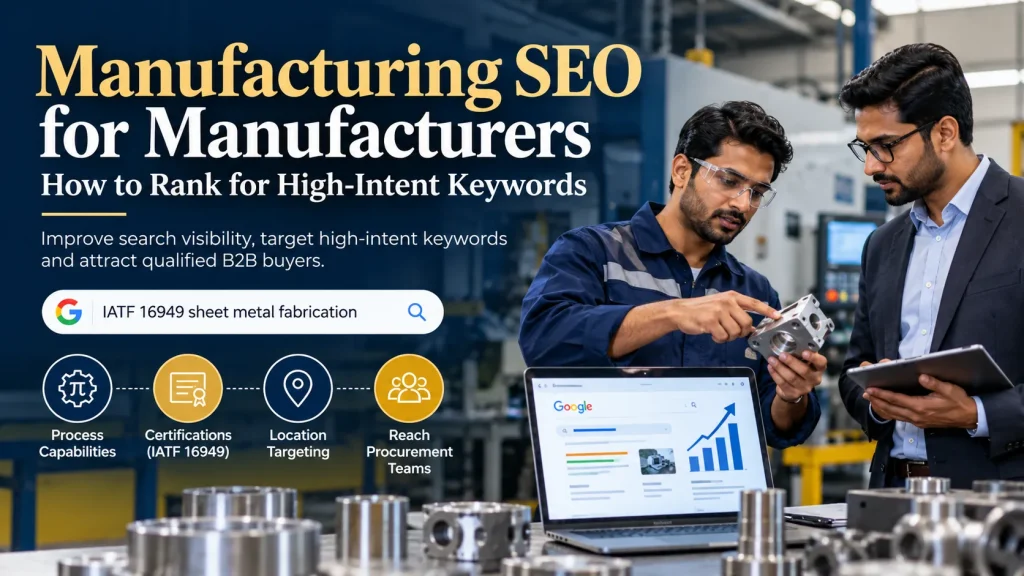
Manufacturing SEO for Manufacturers: How to Rank for High-Intent Keywords
Manufacturing SEO for manufacturers helps industrial businesses improve search visibility, target high-intent keywords, and attract qualified B2B buyers. Learn how to optimize manufacturing capability pages, target process-specific searches, highlight certifications, and strengthen technical SEO to connect with procurement teams and generate relevant business enquiries.
Most manufacturing companies either skip SEO entirely, assuming procurement teams only use trade portals, or treat it exactly like consumer SEO — chasing broad, high-volume keywords that never convert into a serious enquiry. Both approaches miss what actually makes manufacturing SEO effective: it’s less about volume and more about precision. A procurement manager searching “IATF 16949 sheet metal fabrication Rajasthan” is a smaller search volume than “manufacturing company,” but represents an entirely different level of buying intent.
This distinction matters more with every year that passes, as procurement research shifts increasingly online even for traditionally relationship-driven industrial categories. A buyer who once relied entirely on referrals and trade shows now very often starts with a Google search to build an initial shortlist before a single phone call happens — which means a manufacturer with no organic visibility for the searches their buyers actually run is invisible at exactly the stage where shortlists get built.
🚫 Why Generic SEO Fails for Manufacturers
A generic SEO approach — targeting broad category terms, publishing thin service pages, ignoring technical specificity — routinely fails manufacturers for a structural reason: the people searching aren’t casual browsers. They’re procurement professionals, engineers, and sourcing managers who search with technical precision and evaluate results with technical scrutiny. A page that reads as generic marketing copy rather than credible technical content loses their trust within seconds, regardless of where it ranks.
Manufacturing SEO succeeds by inverting the usual consumer SEO instinct. Instead of chasing the highest search volume keyword, it targets the most specific keyword that still matches genuine buyer intent — process, tolerance, certification, and location combined, rather than a broad category term alone.
There’s also a competitive advantage hiding in this approach that most manufacturers underestimate. Because so few manufacturers invest properly in technically specific SEO content, the competition for these precise, high-intent search terms is often genuinely thin — a well-built capability page can rank meaningfully faster here than an equivalent effort would in a saturated consumer category, simply because so few competitors are doing this work well.
This is also why hiring a generalist agency for manufacturing SEO so often disappoints. An agency used to consumer or SaaS keyword research will naturally gravitate toward the highest-volume terms it can find — because that’s the instinct that works in those categories — without recognizing that for a manufacturer, volume and intent are frequently pointing in opposite directions.
🔑 Manufacturing Keyword Types
| Type | Example | Why It Converts |
|---|---|---|
| Process-specific | “CNC turning services India” | Matches a buyer who already knows exactly what process they need |
| Industry-vertical | “automotive component manufacturer Tier 1” | Signals category fit before the buyer even clicks through |
| Location-based | “sheet metal fabrication Udaipur” | Important for buyers prioritizing logistics proximity or regional sourcing |
| Capability + certification | “IATF 16949 forging supplier” | Filters directly for the compliance-conscious buyer segment least likely to be a job-work shopper |
Notice that the strongest-converting examples above combine two or three of these types rather than relying on just one — a location-based term paired with a certification, or a process term paired with an industry vertical. That layering is deliberate: each additional qualifier narrows the search further toward genuine buyer intent, at the cost of some search volume that, for a manufacturer, was never going to convert anyway. This is the single biggest mindset shift a manufacturer’s marketing team needs to make when moving from consumer-style thinking to industrial SEO.
💡
Every one of these keyword types is lower search volume than a generic term like “manufacturing company” — and that’s precisely the point. Lower volume, higher specificity keywords consistently convert better for manufacturers because they match exactly how a genuine industrial buyer searches.
📄 On-Page SEO for Capability & Process Pages
Manufacturing websites often make the mistake of listing every capability on a single “Services” page. Search engines and buyers alike respond better to a dedicated page per process or capability, each optimized to rank for its own specific keyword set. Use this checklist per page:
- ✓A unique, specific title tag naming the process, not a generic “Our Services” label
- ✓Technical specifications — tolerances, materials, equipment — not just a marketing description
- ✓Certifications relevant to that specific process or industry vertical
- ✓At least one case study or client example relevant to that capability
- ✓A clear, process-specific enquiry or RFQ call to action
A single strong capability page, built this way, will typically outperform ten thin, generic ones — both in ranking and in the quality of enquiry it generates.
It’s worth being honest about the effort this requires, because it’s the main reason so many manufacturer websites stay thin for years: writing technically accurate content for a CNC machining page versus an injection molding page versus a die casting page genuinely takes distinct subject-matter input each time, not a template with the process name swapped out. Buyers can tell the difference between a page written by someone who understands the process and one that’s been lightly reworded from a generic template — and so, generally, can search engines evaluating depth and originality of content.
⚙️ Technical SEO Priorities
⚡
Page speed
Manufacturing sites are often image and video-heavy (plant tours, equipment galleries) — unoptimized media is a common speed killer.
📱
Mobile usability
A growing share of initial procurement research now happens on mobile, even for eventual desktop-based RFQ review.
🗺️
Structured data
Schema markup for organization, certifications, and local business details helps search engines understand credibility signals.
🔗
Internal linking
Linking related capability and industry pages together helps both search engines and buyers navigate your full range logically.
None of these are exotic technical requirements — most are achievable without a full website rebuild. But they’re routinely neglected on manufacturer websites that were built primarily as a digital brochure rather than a search-optimized asset, which means fixing them is often the fastest, lowest-cost win available before investing in new content at all.
✍️ Content That Actually Ranks
Beyond capability pages, the content types that consistently perform well for manufacturing SEO are technical case studies (with real specifications and outcomes, not vague success language), process documentation and explainer content that demonstrates genuine expertise, and certification-focused content explaining what a specific standard means for the buyer’s own quality requirements. This kind of content does double duty — it ranks for the specific searches procurement teams run, and it functions as exactly the vetting-stage credibility material discussed in our guide on generating qualified OEM leads.
A well-built technical case study, in particular, tends to punch well above its weight for manufacturing SEO. It naturally contains the exact combination of process terms, industry vertical language, and specific outcomes that procurement teams search for, while also being genuinely persuasive reading for a buyer evaluating whether you can handle their specific requirement — content that serves both the search engine and the human reader at the same time, rather than being optimized for one at the expense of the other.
⏱️ How Long Manufacturing SEO Takes
Technical fixes live
2–4 weeks
Initial ranking movement
2–3 months
Meaningful traffic growth
4–6 months
Established authority rankings
8–12 months
Manufacturing keywords are often meaningfully less competitive than consumer keywords, which genuinely can speed up early results compared to a crowded consumer category — but the compliance-conscious, technically specific content this guide describes still takes real time to build properly and for search engines to fully trust.
The timeline above assumes a genuine, sustained effort — a handful of capability pages published once and then abandoned won’t follow this curve. Manufacturers who see the strongest results treat SEO as an ongoing content program, adding a new process page, case study, or certification explainer on a regular cadence, rather than a one-time project that’s considered finished once the initial site build is complete.
Manufacturing SEO isn’t a traffic strategy. It’s a credibility strategy that happens to also generate traffic.
That reframing matters when deciding how to measure success. A manufacturer judging SEO purely on total visitor count will often conclude it isn’t working, even while it’s quietly doing its real job — putting the right technical page in front of the right procurement manager at the exact moment they’re building a shortlist. Traffic is the visible output; qualified enquiries and shortlist inclusion are the actual outcomes worth tracking.
❓ Frequently Asked Questions
The core difference is specificity — manufacturing SEO targets process, certification, and technical-capability keywords rather than broader B2B service terms, matching how procurement teams actually search.
Generally no — for manufacturers, lower-volume, highly specific keywords (process + certification + location) tend to convert far better than broad, high-volume category terms.
Yes, ideally — a dedicated, technically detailed page per capability consistently outperforms a single page listing every service briefly.
Meaningful lead generation typically follows the traffic growth curve, so expect the first genuinely qualified SEO-driven enquiries somewhere in the 4–6 month range, growing from there.
Yes — technically accurate capability and process page content, built around your specific certifications and equipment, is a core part of our manufacturing SEO service.
It still helps — many buyers filter by regional proximity for logistics reasons even when a supplier ships nationally, so location-based pages capture a meaningful segment of search intent worth targeting alongside your broader national visibility.

Want to know which keywords your procurement buyers actually search?
We’ll audit your current site and show you exactly which process and capability keywords you’re missing.
📚 Related Reads
OEM Lead Generation for Manufacturers: How to Attract Qualified OEM and Tier-1 Buyers
IndiaMART vs TradeIndia vs Website: Which Is Best for Manufacturers?
Manufacturing Lead Nurturing: How to Convert B2B Leads into Sales
Lead Generation for Manufacturers in India: Proven B2B Strategies to Get Quality Leads