
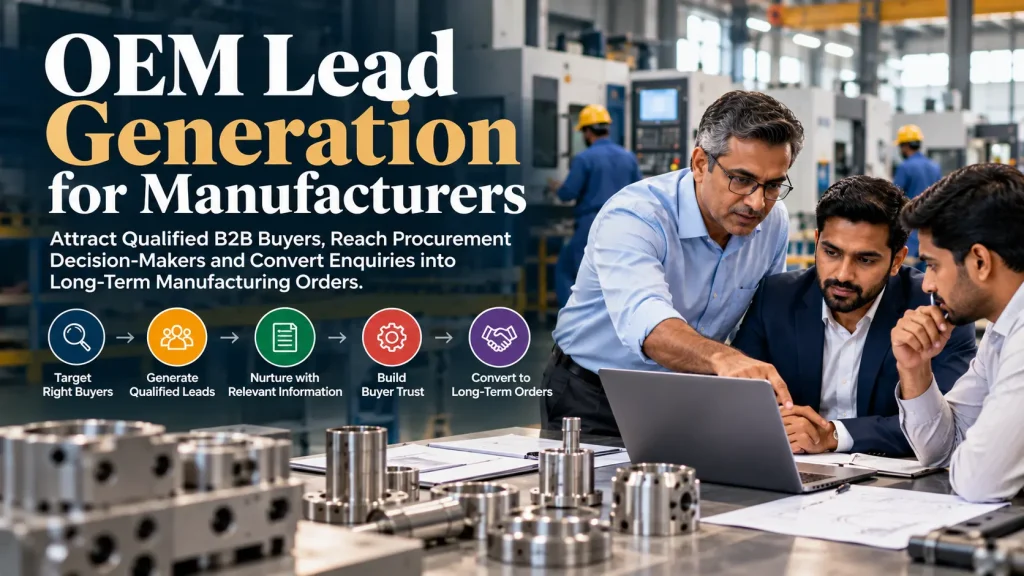
OEM Lead Generation for Manufacturers: Attract Qualified B2B Buyers
OEM lead generation for manufacturers helps you connect with qualified OEM and Tier-1 buyers, reach procurement decision-makers, and generate relevant B2B enquiries. Learn how to build buyer trust, strengthen your digital presence, reduce low-quality job-work enquiries, and turn qualified prospects into long-term manufacturing orders.
Ask most manufacturing companies about their digital marketing, and you’ll hear a version of the same complaint: “We get enquiries, but they’re the wrong ones.” Small job-work requests. Price-shoppers with no volume intent. Traders fishing for a quote to resell. Meanwhile, the OEM and Tier-1 orders that actually move revenue keep going to competitors who, on paper, aren’t doing anything more sophisticated. The difference almost always comes down to how deliberately a manufacturer targets, qualifies, and nurtures leads — not how much they spend.
This guide breaks down what actually generates qualified OEM leads: who’s searching, where they search, what a genuine vendor approval journey looks like from an OEM’s side, and the specific digital signals that separate a manufacturer that gets shortlisted from one that gets ignored.
It’s worth naming the underlying shift here, because it changes how you should think about the whole exercise: OEM lead generation isn’t a volume game the way consumer lead generation often is. A manufacturer chasing 500 enquiries a month from a broad campaign is usually working harder for a worse outcome than one generating 15 tightly targeted enquiries that actually match their ideal client profile. The goal isn’t more traffic — it’s the right five companies noticing you at the right moment in their sourcing cycle.
🎯 What Makes an OEM Lead “Qualified”
Not every enquiry that lands in your inbox is worth the same attention. Before building a lead generation strategy, it helps to define — precisely, not vaguely — what a qualified OEM lead actually looks like for your business.
The reason this distinction matters isn’t just about sales team efficiency — it changes what your marketing should actually be optimizing for. A campaign tuned to generate volume will fill your inbox with the right-hand column. A campaign tuned to generate qualified pipeline needs different keywords, different content, and a different targeting logic entirely, which is exactly what the rest of this guide covers.
🔍 Where OEM Buyers Actually Search
OEM procurement teams don’t discover new suppliers the way a retail consumer discovers a product. Their research is deliberate, spread across multiple channels, and happens well before they ever fill out a contact form.
💡
By the time an OEM procurement team fills out your enquiry form, they’ve usually already checked your website, your LinkedIn page, and possibly your certifications independently. Your digital presence isn’t generating the lead at that point — it’s confirming or killing it.
🧭 The OEM Vendor Approval Journey
Understanding the stages an OEM actually goes through before placing an order changes how you should sequence your marketing and follow-up. Here’s the typical path:
Discovery
Initial Shortlisting
Procurement or engineering identifies a shortlist of potential suppliers via search, referrals, or trade portals — typically 5–10 companies at this stage.
Vetting
Capability & Compliance Review
The shortlist is narrowed based on certifications, capability match, and credibility signals — website depth, case studies, and LinkedIn presence all get checked here.
RFQ
Request for Quotation
Technical drawings and specifications are shared with the surviving 2–4 vendors, who submit detailed technical and commercial quotations.
Sample / Trial
Quality & Sample Approval
Sample parts are produced and evaluated against tolerance and quality requirements — often the longest single stage in the process.
Order
Vendor Onboarding & First PO
Once approved, the vendor goes through internal onboarding — sometimes including a plant audit — before the first production order is placed.
Most manufacturers only market to stage one — trying to generate the initial shortlist enquiry — and then leave stages two through five entirely to their sales team. That’s a missed opportunity: content and digital presence can actively support stages two and three, where a large share of vendors get eliminated before a human conversation even happens.
Stage four — sample and trial approval — is worth calling out specifically, because it’s where marketing’s job technically ends but its influence doesn’t. A buyer who had a positive research experience with your company (clear technical content, responsive follow-up, credible case studies) tends to extend more benefit of the doubt during a sample evaluation than one who found your vetting stage frustrating or thin. First impressions from stage one and two carry forward further into the relationship than most manufacturers assume.
✅ Building a Vendor-Approval-Ready Digital Presence
Since a meaningful share of vetting happens before any human contact, your website and LinkedIn presence need to do real qualifying work on their own. Use this checklist:
- ✓Certifications (ISO, IATF, AS9100, etc.) displayed prominently, not buried in a footer
- ✓Equipment list and process capabilities documented in specific, technical detail
- ✓Case studies or client references relevant to the buyer’s industry (automotive, pharma, electronics)
- ✓Plant photos or video — real facility imagery, not stock photography
- ✓A dedicated RFQ or technical enquiry form, separate from a generic “contact us”
- ✓LinkedIn company page with active posting — an inactive page is itself a credibility red flag
None of this replaces your sales team’s relationship-building — but it determines whether your company survives the digital vetting stage long enough for that relationship-building to happen at all.
💼 LinkedIn Targeting for Procurement Teams
LinkedIn is where OEM decision-makers are most reliably active, which makes it the highest-leverage channel for direct targeting rather than broad-net visibility. Effective LinkedIn strategy for OEM lead generation typically combines three elements: precise job-title and company targeting (procurement heads, supplier development managers, sourcing leads at named target accounts), consistent thought-leadership content that builds recognition before outreach ever happens, and direct InMail or connection outreach timed to industry events or sourcing cycles specific to your target sector.
The mistake we see most often is treating LinkedIn as a place to post generic company updates rather than a targeting and relationship-building tool. A well-run LinkedIn account for a manufacturer looks less like a marketing feed and more like a sustained, visible presence in front of a specific, named list of target accounts.
🚧 Why Manufacturers Get Job-Work Enquiries Instead of OEM Orders
🔤
Generic keyword targeting
Ranking or advertising for broad terms like “manufacturing company” attracts broad, unqualified traffic instead of specific process-seekers.
📄
Thin capability content
A website that lists services in one line, with no technical depth, fails the vetting stage before an OEM ever reaches out.
🏷️
No minimum order signaling
Without a clear minimum volume or ideal client profile stated anywhere, small job-work seekers assume you’re a fit.
👻
Dormant LinkedIn presence
An inactive or thin LinkedIn page reads as a red flag to procurement teams doing quiet due diligence.
📊 Metrics That Actually Predict OEM Pipeline Health
Given how long OEM sales cycles run, waiting for closed orders to judge whether marketing is working means waiting 6–12 months for a signal. Track these leading indicators instead:
An OEM lead generation strategy that only counts total enquiries is optimizing for the wrong number entirely.
❓ Frequently Asked Questions
How long does it take to start generating qualified OEM leads?
Initial qualified enquiries can appear within 2–3 months of a properly targeted campaign, but given typical 3–12 month OEM decision cycles, meaningful order conversion usually takes 6–12 months to materialize from the first lead.
Should we target OEMs directly or work through Tier-1 suppliers?
Both are valid — Tier-1 relationships often have shorter approval cycles since they’re already vetted by the OEM, while direct OEM relationships typically offer higher volume but longer, more rigorous vetting.
Is LinkedIn worth the investment for a smaller manufacturing company?
Yes, arguably more so — LinkedIn’s precise targeting means a smaller company can reach the exact procurement decision-maker at a target account without needing the brand recognition a larger competitor might rely on elsewhere.
How do we filter out job-work enquiries without turning away good leads?
Be explicit about minimum order quantities, ideal client profile, and certifications on your website and enquiry form — this self-selects serious buyers without requiring manual filtering of every enquiry.
Can Brand Chanakya help target specific OEM accounts?
Yes — account-based LinkedIn targeting of named procurement decision-makers at specific OEM and Tier-1 companies is part of our B2B manufacturing marketing approach.

Want a free audit of your current OEM lead quality?
We’ll review your enquiries, website, and LinkedIn presence and tell you exactly why you’re getting job-work leads instead of OEM orders.
📚 Related Reads
Manufacturing Lead Nurturing: How to Convert B2B Leads into Sales
IndiaMART vs TradeIndia vs Website: Which Is Best for Manufacturers?
Manufacturing SEO for Manufacturers: How to Rank for High-Intent Keywords
Export Marketing for Manufacturing Companies: How to Reach Global Buyers and Win International Orders