
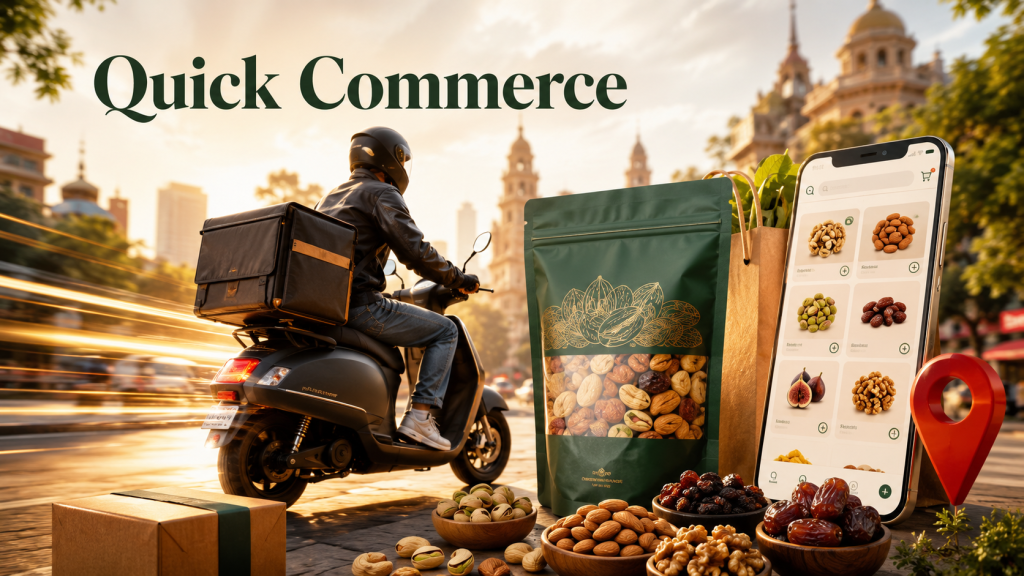
Quick commerce is reshaping how India buys groceries. Blinkit, Zepto, and Swiggy Instamart promise 10-minute delivery — and dry fruits are a top-performing category. If you’re not on these platforms, you’re missing out on impulse buyers and metro customers who value convenience over price.
What is Quick Commerce?
Quick commerce (Q-commerce) delivers groceries and essentials in 10-30 minutes through a network of dark stores — small fulfillment centers located in residential areas. Unlike Amazon, which ships from distant warehouses, q-commerce stores inventory within 2-3 km of customers.
How It Works
- Brand supplies inventory to dark stores across cities
- Customer orders on the Blinkit/Zepto/Instamart app
- Dark store picks & packs in under 2 minutes
- Delivery rider delivers in 10-20 minutes
Amazon/Flipkart: You manage inventory; they handle delivery. Quick Commerce: They manage inventory in their dark stores, you supply stock. This means faster turns but less control over stock levels.
Platform Comparison
Why Quick Commerce for Dry Fruits?
- Impulse category: “I want almonds right now” — q-commerce captures this demand
- High AOV: Dry fruits average ₹400-800 per order vs ₹250 platform average
- Repeat purchases: Health-conscious buyers reorder every 2-3 weeks
- Gifting moments: Last-minute gift needs — q-commerce delivers in minutes
- Metro audience: Affluent, time-poor customers who pay for convenience
- Shelf-stable: No cold chain needed, longer inventory shelf life
While product quality drives repeat purchases, long-term success also depends on effective ecommerce marketing. A well-planned ecommerce strategy improves product visibility, marketplace performance, customer acquisition, and sales growth across Blinkit, Zepto, Swiggy Instamart, and Amazon.
Requirements & Documents
📋 Documents Checklist
FSSAI License: State or Central (not basic registration)
GST Certificate: Active GST registration
Trademark: Registered or applied trademark proof
PAN Card: Business PAN
Bank Details: Cancelled cheque or bank letter
Product Catalog: SKU list with MRP, weight, images
Quality Certificates: ISO, HACCP (increases approval chances)
Test Reports: Lab test reports for quality claims
Packaging Requirements
- FSSAI license number clearly printed
- Best before date (minimum 6 months shelf life preferred)
- Net weight and MRP (MRP stickers must be tamper-proof)
- Nutritional information panel
- Allergen warnings (nuts contain allergens)
- Barcode (EAN-13 preferred)
Onboarding Process
- Blinkit: seller.blinkit.com
- Zepto: Contact through business inquiry form
- Instamart: partners.swiggy.com
- FSSAI, GST, Trademark proof
- Product images (white background, 1000x1000px)
- SKU master with MRP, weight, barcode
- Brand fit assessment
- Pricing competitiveness check
- Quality and packaging review
- Commission rates (25-35%)
- Payment cycle (typically 15-30 days)
- Initial cities and dark store coverage
- Dispatch inventory to designated warehouses
- Quality check at receiving
- Listing goes live on app
Onboarding typically takes 4-8 weeks from application to going live. Factor in time for document verification, category team approval, and inventory dispatch. Start the process 2-3 months before your target launch date.
Margins & Unit Economics
💰 Quick Commerce vs Amazon: ₹500 MRP Pack
| Factor | Quick Commerce | Amazon FBA |
|---|---|---|
| Platform Commission | 25-35% | 15-22% |
| Fulfillment Cost | Included | 8-12% extra |
| Storage Cost | None | ₹25-50/unit/month |
| Net Margin (typical) | 65-75% | 70-80% |
| Inventory Turns | 12-15x/year | 6-8x/year |
| Working Capital | Lower (fast turns) | Higher (slow turns) |
Winning Strategy for Dry Fruits
SKU Selection
- Focus on fast-movers: Almonds, cashews, mixed nuts, trail mixes
- Right pack sizes: 200g-500g packs work best (₹200-600 price range)
- Premium variants: Q-commerce customers pay for quality
- Avoid bulk packs: 1kg+ packs don’t fit impulse buying behavior
Pricing Strategy
- Price at MRP — q-commerce customers accept it for convenience
- No deep discounting needed (unlike Amazon)
- Factor 28-35% platform fee into your MRP calculation
- Consider q-commerce-specific SKUs with adjusted MRP
Inventory Management
- Maintain 2-3 weeks buffer stock at dark stores
- Monitor stock levels daily — stockouts kill visibility
- Coordinate with the platform’s supply chain team
- Plan for festive spikes (2-3X normal demand)
Need Help with Quick Commerce?
Brand Chanakya helps dry fruit brands onboard and scale on Blinkit, Zepto, and Instamart. From documentation to inventory strategy — we handle the complete q-commerce journey.
Frequently Asked Questions
How do I start selling dry fruits on Blinkit?
+
Selling dry fruits on Blinkit starts by registering your business, obtaining the required licenses, and completing Blinkit’s seller onboarding process in India.
To sell dry fruits on Blinkit, you need a valid FSSAI license, GST registration, PAN, bank details, product catalog, and compliant packaging. After your application is approved, you supply inventory to Blinkit’s dark stores, where your products become available for customers across supported Indian cities. Optimized pricing, attractive packaging, and reliable inventory management help improve sales and visibility on Blinkit.
What are the margins on quick commerce vs Amazon?
+
Quick commerce usually offers faster inventory turnover, while Amazon often provides slightly higher product margins for Indian sellers.
Quick commerce platforms like Blinkit, Zepto, and Swiggy Instamart generally charge commissions between 25% and 35%, whereas Amazon commissions are often lower depending on the category. However, quick commerce generates faster repeat purchases and higher inventory rotation, making it profitable for fast-moving dry fruit products. Many successful Indian brands use Amazon for long-term sales and quick commerce for instant-demand products.
Which quick commerce platform is best for dry fruits?
+
Blinkit is generally the best quick commerce platform for selling dry fruits in India because of its large grocery customer base and extensive dark store network.
Zepto is growing rapidly among younger urban consumers, while Swiggy Instamart performs well in cities with strong Swiggy adoption. Instead of relying on one platform, many Indian dry fruit brands expand across Blinkit, Zepto, and Swiggy Instamart to increase visibility, customer reach, and overall sales.
What FSSAI requirements for quick commerce?
+
To sell dry fruits on quick commerce platforms in India, you need a valid State or Central FSSAI License along with FSSAI-compliant product packaging.
Your product labels should display the FSSAI license number, product name, net quantity, MRP, nutritional information, manufacturing and expiry dates, allergen declaration, and other mandatory details required under Indian food safety regulations. Meeting FSSAI compliance helps ensure faster onboarding and uninterrupted selling on Blinkit, Zepto, Swiggy Instamart, and other online grocery platforms.
Brand Chanakya Team
Brand Chanakya helps food and FMCG brands scale on quick commerce platforms. From onboarding to growth strategy, we’ve managed ₹1 Cr+ ad spend for ecommerce clients across India.
Related Guides for Dry Fruit Brands
Quick Commerce Dry Fruits in India: Trends & Growth
A deep dive into consumer buying behavior driving dry fruit sales on Blinkit, Zepto, and Instamart.
How to Sell Dry Fruits on Amazon India: Complete Seller’s Guide
Compare Amazon FBA margins, fulfillment costs, and listing strategy against the quick commerce model.
D2C vs Marketplace for Dry Fruits
Which channel builds better long-term margins and customer ownership for a dry fruit brand?
Dry Fruits Packaging Design: Best Ideas & Branding Tips
FSSAI-compliant packaging that also stands out on a crowded Blinkit or Zepto shelf.