
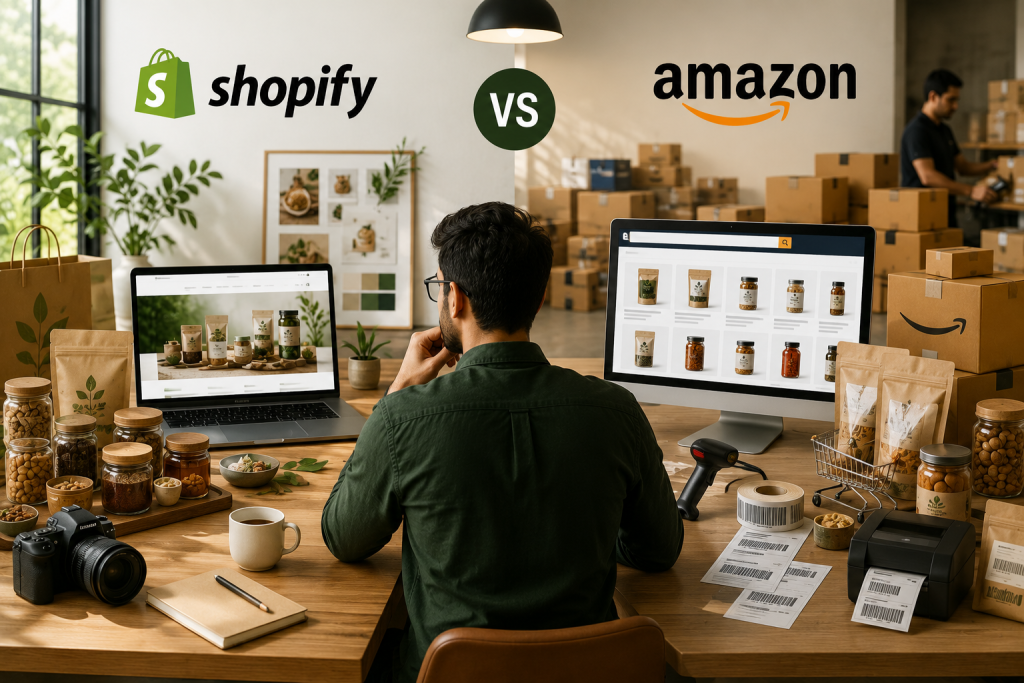
This is the question we hear most often from organic food founders in their first year: should I focus on Amazon or build my own Shopify store? The honest answer is that they solve different problems, and picking the wrong one at the start slows your growth by months. Here’s how to think about it clearly.
The Core Difference: Reach vs Control
Amazon gives you access to millions of buyers who already trust the platform enough to enter their card details. Shopify gives you full control over your brand experience, pricing, customer data, and margins — but you have to bring your own traffic.
Side-by-Side Comparison
| Factor | Amazon | Shopify (D2C) |
|---|---|---|
| Commission per sale | 15-18% | 2-3% (payment gateway only) |
| Traffic source | Built-in marketplace search | You must drive your own traffic |
| Customer data ownership | Limited, Amazon owns the relationship | Full ownership of email, phone, behaviour data |
| Time to first sale | Days to weeks | Weeks to months |
| Subscription flexibility | Amazon Subscribe & Save, fixed rules | Fully customizable subscription logic |
| Brand storytelling space | Limited to A+ content and brand store | Unlimited, full page control |
| Margins at scale | Lower, due to fees and ad spend | Higher, 35-45% better typically |
When Amazon Wins
- You are a brand-new label with zero reviews or brand recognition
- You need cash flow quickly and can’t wait months for D2C traffic to build
- Your category (staples, oils) benefits from Subscribe & Save behaviour patterns already present on Amazon
🚀 Need Help Launching on Amazon?
Getting your listings, A+ content, and ad spend right from day one matters more than most new sellers realise — a poorly optimised launch burns budget without building the review base you actually need. Our Amazon marketing services handle exactly this — listing optimisation, A+ content, and ad management — so your first 90 days actually build a foundation, not just spend.
When Shopify Wins
- You have a strong farm story or founder story that differentiates you meaningfully
- You want to build a subscription box model with full control over bundling and cadence
- You are working with healthier margins already and can afford to invest in traffic (SEO, ads, content)
Expert Tip
Use Amazon reviews as social proof on your Shopify store. Screenshot verified Amazon reviews (with permission) into your D2C product pages — it borrows trust from a platform buyers already believe in.
A Realistic Sequencing Approach
- Launch on Amazon first to validate demand and gather reviews
- Once you have 50+ reviews and consistent monthly sales, build your Shopify store
- Use Shopify for subscriptions, premium bundles, and higher-margin SKUs
- Keep Amazon running for volume and new customer discovery
Common Mistake
Building an expensive Shopify store before validating that your product actually sells. Many organic brands spend ₹1-2 lakh on a D2C site before confirming demand on a lower-cost channel first.
What This Means for Subscription Revenue
Organic staples like rice, ghee, and honey are naturally repeat purchases. Amazon’s Subscribe & Save captures some of this, but Shopify subscriptions typically convert better long-term because you control the discount structure, bundling, and reminder messaging directly.
Cost of Running Each Channel
| Cost Type | Amazon | Shopify |
|---|---|---|
| Platform fee | Selling plan ₹500-2,000/month | Shopify plan ₹2,000-8,000/month |
| Traffic cost | Sponsored ads, pay per click | SEO + Meta/Google ads, higher upfront investment |
| Content need | A+ content, images | Full website copy, blog, email flows |
How Buyer Trust Differs Between the Two
On Amazon, trust is largely borrowed — buyers trust Amazon’s return policy and buyer protection more than they trust your specific brand initially. On Shopify, trust has to be built entirely by you, through certifications, reviews, founder visibility, and transparent policies. This is why brand-new organic labels often struggle to convert well on a standalone D2C site before they’ve proven themselves elsewhere.
What Builds Trust on Each Platform
| Trust Factor | Amazon | Shopify |
|---|---|---|
| Reviews and ratings | Critical, visible immediately | Important but needs to be actively displayed |
| Return policy clarity | Standardized by Amazon | You must clearly state and honour your own policy |
| Certification visibility | Images and A+ content | Homepage, product pages, and dedicated trust page |
| Founder/farm story | Limited space | Full flexibility, a genuine advantage |
Long-Term Growth Trajectory
Over a 2-3 year horizon, brands that build both channels well typically see Shopify’s share of revenue grow steadily as subscription customers accumulate, while Amazon continues to serve as the primary new-customer acquisition engine. Neither channel should be abandoned in favour of the other — they serve different, complementary roles in the customer journey.
What About Flipkart, Blinkit, and Other Marketplaces?
This comparison focuses on Amazon versus Shopify because they represent the two clearest ends of the spectrum — marketplace reach versus D2C control. In practice, Flipkart Grocery behaves similarly to Amazon for decision-making purposes, while Blinkit, Zepto, and Instamart serve a different job entirely: capturing impulse and urgency-driven purchases rather than researched decisions. None of these should be seen as a replacement for the Amazon-vs-Shopify decision — they’re additive channels once your core strategy is working.
A Simple Decision Framework
| Your Situation | Recommended Starting Point |
|---|---|
| Brand-new label, no reviews yet | Amazon first |
| Established offline brand entering online | Shopify first, using existing offline trust |
| Premium/niche product with strong story | Shopify first, Amazon as secondary |
| Staple/commodity-style product (rice, pulses) | Amazon first, for Subscribe & Save behaviour |
Key Takeaways
- Amazon wins on reach and speed to first sale; Shopify wins on margins and control
- New organic brands usually benefit from starting on Amazon
- Shopify becomes valuable once you want subscriptions and premium storytelling
- Most mature organic brands run both channels, not one or the other
- Don’t build a D2C store before validating product-market fit elsewhere
- Your starting point depends on your product type and existing brand trust, not a fixed rule
Handling the Transition From Amazon-Only to Both Channels
When it’s time to add Shopify alongside an existing Amazon presence, avoid launching it as a carbon copy of your marketplace listings. Use the D2C site to go deeper — longer farm story content, founder video, subscription bundles that Amazon’s rules don’t allow, and a loyalty program. If the D2C site simply mirrors Amazon at a higher price with no added value, customers have no reason to buy there instead.
- Offer something exclusive to D2C — a bundle, an early-access product, or a loyalty discount
- Use email and WhatsApp lists built from Amazon packaging inserts to redirect existing customers to your D2C site over time
- Keep pricing consistent or slightly better on D2C to reward the customers willing to buy direct
Conclusion
There is no universal winner between Shopify and Amazon for organic food brands — the right choice depends on your stage. New brands should validate on Amazon first; established brands should build Shopify alongside it to capture margin and subscription revenue that marketplaces can’t offer.
Not Sure Which Platform Fits Your Stage?
Get a free growth audit and a clear platform roadmap for your organic food brand.
Frequently Asked Questions
Is Shopify better than Amazon for organic food brands?
Shopify offers better margins and full control over customer data, while Amazon offers faster access to buyers who already trust the platform. Most organic brands need both, used differently.
Which platform is cheaper to start on?
Amazon has a lower upfront cost since it requires no website build, but takes 15-18% commission per sale. Shopify has setup costs but no per-sale commission beyond payment gateway fees.
Can I sell on both Shopify and Amazon at the same time?
Yes, and most successful organic brands do exactly this — Amazon for reach and trust, Shopify for margins and subscription revenue.
Which platform is better for organic subscription boxes?
Shopify, because it allows full customization of subscription cadence, bundling, and customer communication.
Does Amazon or Shopify build more brand trust for a new label?
Amazon builds trust faster for a brand-new label because of existing marketplace reviews. Shopify builds trust over time through storytelling and direct relationships.
Which platform is easier to manage with a small team?
Amazon is generally easier initially since fulfilment and payment infrastructure already exist. Shopify requires more setup but gives more long-term control.
Related Reads
Strategy
Ecommerce Marketing for Organic Food Brands
Read more →
Getting Started
How to Sell Organic Food Online
Read more →
Comparison
D2C vs Marketplace: Dry Fruits Edition
Read more →
Comparison
D2C vs Marketplace: Supplements Edition
Read more →
Platform
Shopify vs WooCommerce Comparison Guide
Read more →
Platform
Best Ecommerce Platform in India
Read more →
Growth
D2C Brand Growth Strategy in India
Read more →
Comparison
Amazon vs Flipkart vs Meesho: Seller Comparison
Read more →