
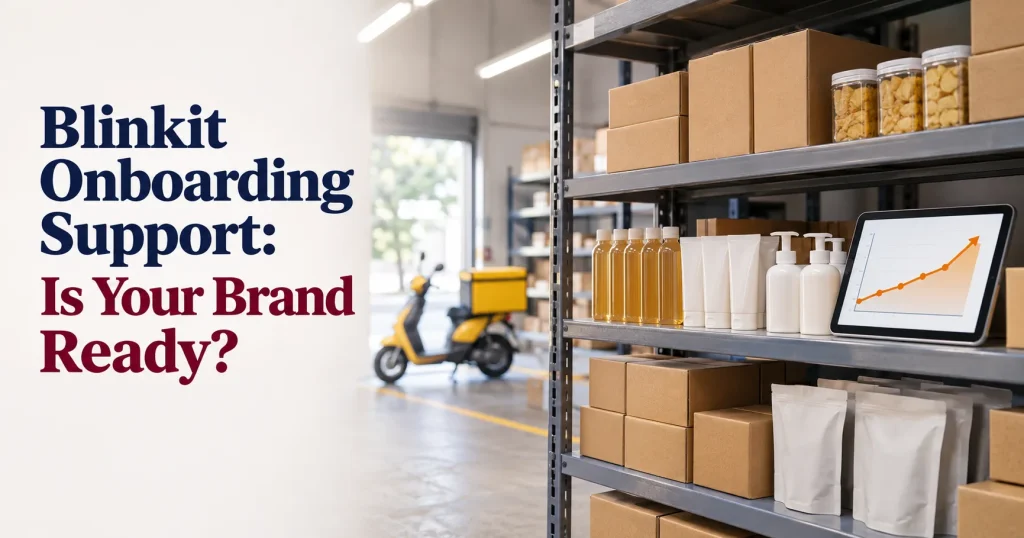
Quick commerce looks like the fastest way to put an FMCG or D2C brand in front of city shoppers. Many founders ask how quickly they can get on Blinkit. The better first question is whether the brand is ready to launch and sustain sales there.
Getting listed is only the start. Products then have to be supplied to the platform reliably, priced to compete, presented well in a small mobile tile, and supported with visibility, while still making money after the platform's commercial terms. Brands that rush onboarding without preparing for these often see a short burst of sales followed by stockouts, poor ratings or unprofitable promotions.
This article explains what Blinkit onboarding support should cover, how to judge your brand's readiness, why no agency can guarantee approval, timing or commercial terms, and how to plan the period after going live.
Is Your Brand Ready for a Quick-Commerce Launch?
Use this readiness check before investing time in onboarding.
| Readiness area | Ready when… | Not ready when… |
|---|---|---|
| Product fit | Everyday, frequently bought or impulse items suited to fast delivery in cities | Products needing explanation, installation or long consideration |
| Pack size and price | Pack sizes and price points that suit quick top-up purchases | Only large or premium packs that rarely fit a quick-commerce basket |
| Compliance | Licences and labelling required for your category are in order (for example, FSSAI for food) | Labels missing mandatory details; licences pending |
| Brand | Clear brand name, ideally trademark registered or applied for; consistent packaging | Frequently changing names or packaging |
| Supply | Ability to supply agreed quantities to the platform's warehouses on schedule | Irregular production or long lead times |
| Economics | Contribution per unit remains positive after platform terms, logistics and launch promotions | Margins only work at full price with no marketing |
| Team | Someone owns the account, stock planning and reporting | Nobody has time after launch |
Table 1. Brand readiness check for Blinkit. Requirements vary by category; confirm with Blinkit.
If several items fall in the right-hand column, onboarding support can still help you prepare, but the priority should be readiness rather than speed.
Signs You Would Benefit From Onboarding Support
- ✓You have never sold on a quick-commerce platform and are unsure what the platform will ask for.
- ✓Your catalogue images and product information were designed for retail shelves or your website, not small app tiles.
- ✓You are unclear how the commercial model will affect your margin and cash flow.
- ✓You have no plan yet for which SKUs and cities to start with, or how to support the launch.
- ✓Your team cannot spare time to manage documentation, catalogue and follow-up alongside daily operations.
What Goes Wrong When Brands Launch Too Early
- ✓Initial orders arrive, but replenishment cannot keep up; products show as out of stock and lose visibility.
- ✓Launch discounts drive trial but leave little or no margin once platform terms and logistics are counted.
- ✓Small-screen product images and unclear pack information lead to low conversion or wrong expectations.
- ✓Early ratings suffer from packaging damage or quality issues, making later recovery expensive.
- ✓Without a post-launch plan, the brand pays for visibility in cities where it is not reliably available.
A slower, better-prepared launch usually costs less than recovering from a weak one.
What Blinkit Onboarding Support Should Cover
| Workstream | What it involves |
|---|---|
| Readiness review | Assess products, packs, pricing, compliance, supply capacity and economics |
| Documentation | Organise business, tax, brand and category documents the platform requests |
| Catalogue preparation | Product titles, attributes, pack details, images designed for small mobile tiles, and compliance information |
| Platform evaluation | Understand the commercial model offered (for example, marketplace or outright purchase arrangements) and what it means for margin and cash flow |
| Launch planning | Priority SKUs and cities, initial stock, launch visibility and promotions with a budget and success criteria |
| Handover or ongoing management | Clear plan for who runs the account after launch |
Table 2. Typical onboarding support workstreams.
Our existing guides cover the details: documents required for Blinkit seller registration, Blinkit SOR vs OR model explained and how to choose products to sell on Blinkit.
Check Launch Economics Before You Apply
Quick-commerce economics depend on the commercial model, pack size and promotions. Run the numbers per unit before agreeing to launch terms.
| Line per unit (hypothetical) | Amount | Note |
|---|---|---|
| Shelf price to shopper (incl. GST) | ₹149 | Pack size chosen for quick-commerce baskets |
| Price net of GST (5% assumed for this product) | ₹142 | ₹149 ÷ 1.05 |
| Platform commercial margin (assumed 25% of net price) | −₹35 | Varies by category, model and negotiation |
| Product and packaging cost | −₹62 | Your costing |
| Freight to platform warehouse | −₹6 | Depends on distance and volume |
| Contribution before promotions and ads | ₹39 | 142 − 35 − 62 − 6 |
| Launch promotion (₹15 off, brand-funded) | −₹14 | ₹15 ÷ 1.05, if the brand funds the discount |
| Visibility/ads per unit during launch | −₹18 | Launch period assumption |
| Contribution during launch | ₹7 | Thin, but positive |
Table 3. HYPOTHETICAL per-unit launch economics. Every percentage and cost here is an assumption for illustration; GST rates depend on the product, and platform terms vary. Replace with your own figures.
In this example, the product stays marginally positive during launch and healthier after promotions end. If the same calculation turned negative, the brand would need a different pack, a different price, lower launch spend or better terms before going live. Doing this arithmetic early also helps you discuss commercial terms with clarity.
Why Onboarding Support Cannot Guarantee Approval, Timing or Terms
Blinkit decides which brands and products to list, in which locations, on what commercial terms, and when.
An onboarding partner can prepare a complete, professional application, organise documents correctly, present the catalogue well and help you understand the commercial model. It cannot control the platform's category priorities, assortment decisions, approval timelines or commercial terms, which can change. Be wary of anyone who promises guaranteed approval, a fixed go-live date or particular margins.
What to ask instead
Ask what the partner will prepare, how they will keep you informed, what happens if the application needs changes, and what support continues after launch.
How Onboarding and Launch Support Is Typically Delivered
Readiness review
Products, packs, prices, compliance, supply and economics checked.
Prepare
Documents organised; catalogue content and images created.
Submit and follow up
Application and catalogue submitted; queries answered.
Launch plan
Priority SKUs and cities, stock, visibility and promotion budget agreed.
Post-launch
Monitor availability, sales, ratings and economics; decide next steps.
Diagram 1. Onboarding to post-launch flow. Timing depends on the platform's process and how quickly documents and approvals are provided.
Planning a Blinkit launch?Talk to Brand Chanakya about Blinkit onboarding and launch readinessShare your products, packs, cities of interest and supply capacity. We will discuss readiness and a realistic launch plan.Read about our onboarding support →What the Brand Must Provide and Remain Responsible For
| Brand responsibility | Why it stays with you |
|---|---|
| Accurate business, tax, brand and category documents | Legal responsibility and verification |
| Product quality, labelling and packaging fit for quick commerce | Ratings, compliance and damage rates depend on them |
| Supply to platform warehouses on agreed schedules | Availability drives sales and visibility |
| Pricing decisions and margin approval | Only you know costs and acceptable margins |
| Commercial agreement with the platform | Terms are between the brand and Blinkit |
| Budget approval for launch visibility and promotions | Affects profitability directly |
Table 4. Responsibilities that stay with the brand.
Planning the First 90 Days After Launch
The first three months should answer one question: can this product sell repeatedly on Blinkit at a contribution the brand can live with? Track a short list of measures weekly and decide based on evidence.
| Measure | Why it matters | Action if weak |
|---|---|---|
| Availability by city/store | Out-of-stock products lose sales and visibility | Fix replenishment before increasing promotion |
| Sales velocity per SKU | Shows which products have real pull | Focus support on winners; review slow SKUs |
| Ratings and reviews | Affect conversion for every future shopper | Investigate quality, packaging or expectation gaps |
| Contribution after promotions and ads | Shows whether growth is profitable | Adjust offers, packs or spend |
| Repeat purchase signals | Indicate lasting demand | Strengthen retention-friendly packs and visibility |
Table 5. Post-launch measures.
Ongoing account management is a separate service from onboarding. If you do not have someone to run the account after launch, plan for it before going live. See Blinkit account management services.
How to Assess Onboarding Support Proposals
- ✓Does the proposal start with a readiness review, or only with document submission?
- ✓Does it explain the commercial model and its effect on your margin and cash flow?
- ✓Does it include catalogue preparation suited to small mobile tiles?
- ✓Does it state clearly that approval, timing and terms rest with the platform?
- ✓Does it include a post-launch plan, or at least a handover?
- ✓Is it clear who owns the seller account and content?
Who Is Ready Now, and Who Should Prepare First
Ready now
Everyday consumables with compliant labels, suitable packs, reliable supply and tested pricing.
Prepare first
Brands without a stable product range, compliance gaps, or no capacity to supply city warehouses regularly.
Consider other channels first
Products that need explanation or are rarely bought on impulse may do better on marketplaces, retail or D2C initially.
Frequently Asked Questions About Blinkit Onboarding
Can an agency guarantee Blinkit approval?
No. Listing decisions, timing and commercial terms rest with Blinkit. An agency can help you prepare a complete, well-presented application and launch plan.
What documents are typically needed?
Usually business and tax registrations, bank details, brand documents and category-specific licences such as FSSAI for food. Requirements vary; confirm the current list with Blinkit.
How long does Blinkit onboarding take?
It depends on the platform's review process, your category and how quickly documents and catalogue details are ready. Avoid plans that depend on a fixed go-live date.
Should we launch in many cities at once?
Usually not. Start where you can supply reliably and where demand is likely, then expand based on evidence.
Is onboarding support the same as account management?
No. Onboarding prepares and launches; account management runs the account afterwards, including availability, catalogue, promotions, ads and reporting.
What should we do in the first month after going live?
Watch availability, sales velocity, ratings and contribution per unit every week. Fix stock and catalogue problems before increasing promotions or ad spend, and keep a clear record of what you changed and when.
What makes a product suitable for quick commerce?
Frequent purchase, convenient pack sizes, competitive price for the pack, and good presentation in a small product tile. Compliance and reliable supply are essential.